
OAuth - Token Exchange Grant
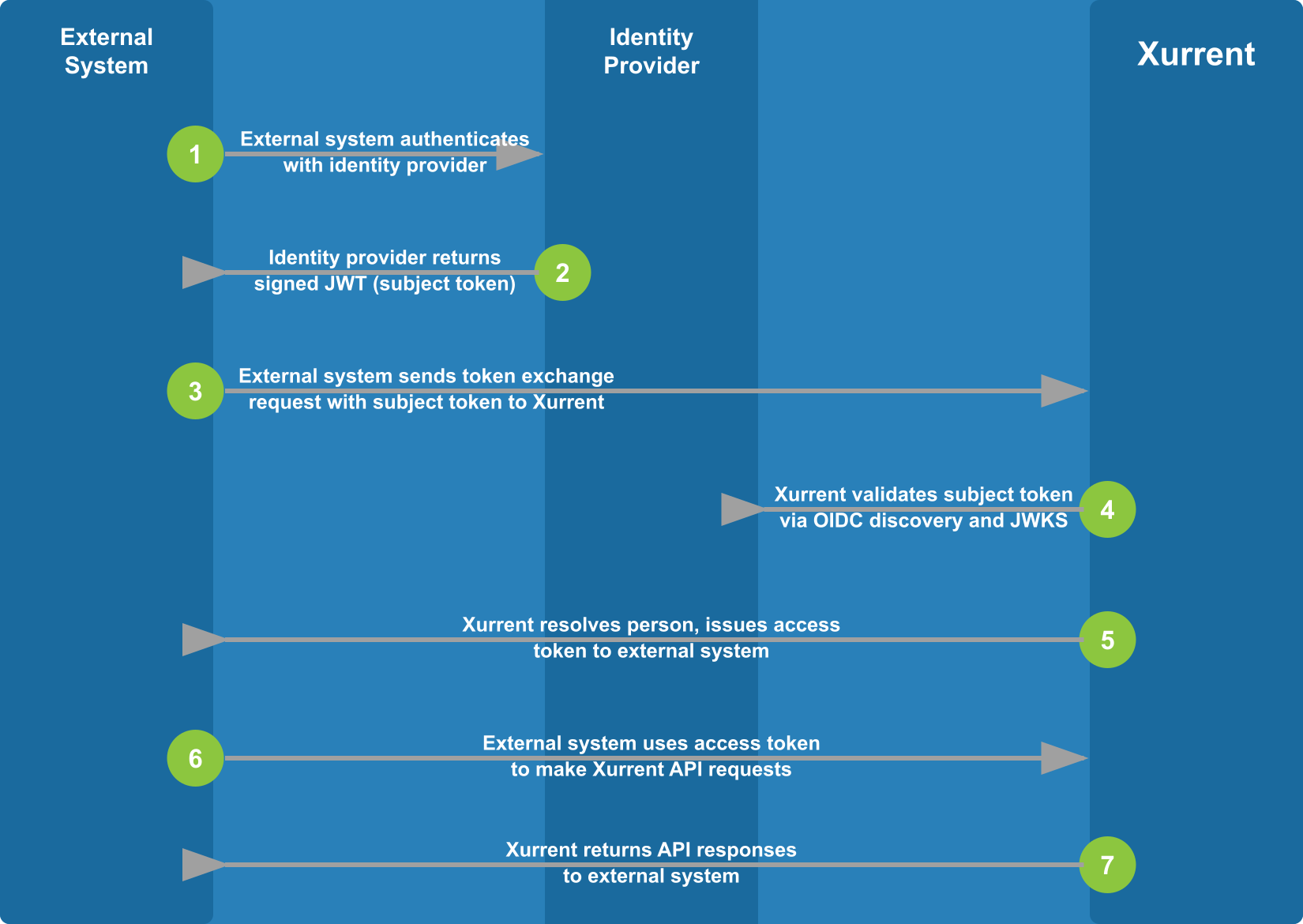
The RFC 8693 Token Exchange grant allows external systems holding third-party identity tokens (e.g. a Teams bot with an Azure AD JWT) to exchange a verified external JWT for a short-lived Xurrent bearer token tied to a resolved person. This enables machine-to-machine flows where the calling system already has a trusted identity token from an OpenID Connect identity provider.
Overview
The token exchange flow works as follows:
-
The external system obtains a JWT from its identity provider (e.g. Azure AD, Okta, Google) through the provider’s normal authentication flow.
-
The external system sends an access token request to Xurrent’s
/tokenendpoint, providing:- the client ID of the OAuth application registered in Xurrent,
- the client secret of the OAuth application registered in Xurrent,
- the external JWT (the “subject token”), and
- the subject token type.
-
Xurrent validates the subject token:
- the token’s signature is verified using the identity provider’s published JSON Web Key Set (JWKS), discovered via OpenID Connect Discovery,
- the issuer is validated against the linked SSO configuration,
- the audience matches the application’s configured audience value, and
- the token has not expired.
-
Xurrent resolves the person from the validated token claims using the SSO configuration’s identifier setting (primary email or authentication ID), searching the application’s account and its directory account.
-
Xurrent issues a short-lived access token (valid for 1 hour) tied to the resolved person and the application’s configured scopes. No refresh token is issued — callers must re-exchange when the token expires.
-
The external system uses the access token to make Xurrent API requests. The token carries the application’s scopes and the resolved person’s identity.
Prerequisites
Before using the token exchange grant, the following must be configured:
-
An OIDC SSO configuration in the Xurrent account (or its directory account) that corresponds to the external identity provider. This SSO configuration provides issuer trust, JWKS discovery, and the person resolution strategy.
-
An OAuth application registered in Xurrent with:
- Grant type set to Token Exchange
- SSO Configuration linked to the OIDC SSO configuration above
- Audience set to the expected
audclaim value in the external JWT - Scopes configured to the permissions the application requires
Access Token request
POST https://oauth.xurrent.com/token
Parameters
Please note: These parameters must be passed via the body of the POST request.
- client_id
- Required string - The client ID that belongs to the OAuth application registered in Xurrent.
- client_secret
- Required string - The client secret you received from Xurrent when you registered the OAuth application in Xurrent.
- grant_type
- Required string - Must be set to
urn:ietf:params:oauth:grant-type:token-exchange. - subject_token
- Required string - The external JWT obtained from the identity provider. This token will be validated against the identity provider’s published JWKS.
- subject_token_type
- Required string - Must be set to
urn:ietf:params:oauth:token-type:jwt.
Response
For valid requests, the client will receive a response with HTTP status code 200, containing:
- access_token
- Required string - Temporary OAuth access
token. Allows the external system to make Xurrent API requests as the resolved
person, constrained by the application’s configured scopes.
The token expires after 1 hour. No refresh token is issued — the caller must
perform a new token exchange to obtain a fresh access token.
The token becomes invalid when:
- the token belonging to the
client_idandclient_secretis disabled or deleted, - the application is disabled,
- the resolved person is disabled.
- the token belonging to the
- issued_token_type
- Required string -
urn:ietf:params:oauth:token-type:access_token. - token_type
- Required string -
bearer. - expires_in
- Required integer - The number of seconds until the access token expires (3600).
Error Responses
For invalid requests an error response with HTTP status code 400 will be returned, containing:
- error
- Required string - Code indicating why the request was invalid. Possible values:
invalid_request— a required parameter is missing or has an invalid value (e.g. wrongsubject_token_type)invalid_grant— the subject token failed validation (expired, wrong issuer, wrong audience, invalid signature, OIDC discovery failure) or the person could not be resolvedunsupported_grant_type— thegrant_typevalue is not recognized
- error_description
- Optional string - Additional information on why the request was invalid.